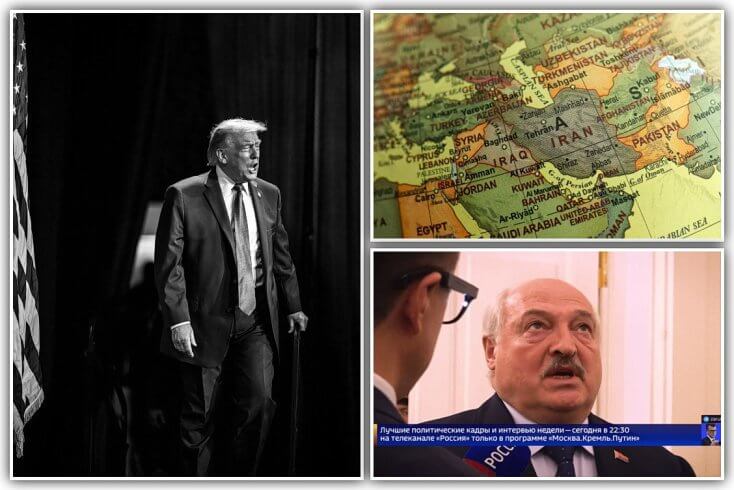
The departure of Alaksandar Łukašenka will inevitably trigger a transformation of the regime. The likelihood of him successfully installing a hand-picked successor is slim. To gain internal legitimacy, any new ruling team will have to break with his legacy. To maintain power, it will need the approval of both Russia and the Belarusian people and elites.
Ruler not getting younger
Political analysts have discussed the possibility of a power transition in Belarus—or a designated successor—since the early 2000s. For nearly two decades, thoughtful minds have debated a question that never truly made it onto the political agenda. After all, transitions are only possible when an autocrat intends to step down—and Łukašenka never has.
For the past 30 years, the topic was largely irrelevant. But now, his age and apparent health decline have made it more urgent.
The challenge, however, lies in unpredictability. This is an equation with many unknowns.
First and foremost, biological clocks are uncertain. Suppose Łukašenka remains in power for another decade. In today’s rapidly changing world, countless internal and external events could reshape Belarus, rendering any long-term forecast meaningless.
We can only speculate based on current conditions—but ten years from now, today’s assumptions may be obsolete. Still, let us explore some likely scenarios.
In personalist regimes, transitions are crises
In personalist authoritarian regimes, there is no institutional mechanism for transferring power—not even within the ruling elite, let alone to the opposition. The departure of a dictator often leads to political crisis.
Łukašenka cannot appoint a successor who would guarantee his safety after leaving office. He simply does not trust anyone—projecting his own history of broken promises onto others.
Over the course of his rule, Łukašenka has alienated many, not only within the opposition but also among high-ranking officials, businesspeople and elite circles. That elite carries its own reservoir of grievances. Few things fuel revenge like personal humiliation.
Years in power have taught Łukašenka that political guarantees and agreements are conditional at best. Their enforcement depends not on legal norms but on the shifting balance of power.
Even Chile’s Augusto Pinochet—who built a complex system of legal protections—could not avoid prosecution after stepping down. Modern history is filled with similar examples.
Furthermore, an officially announced successor quickly becomes a threat to the incumbent, serving as a rallying point for disaffected elites. As loyalty shifts, the incumbent becomes a lame duck.
Handing power to a son? Unlikely.
The widely discussed theory that Łukašenka may hand over power to one of his sons is weak for several reasons.
First, Belarus is a European country. A hereditary, father-to-son transfer of power would likely be rejected by both the public and the elite.
Second, while power can be handed down, retaining it without the father’s protection is another matter entirely. That requires political skill—and so far, none of the sons have demonstrated it.
Łukašenka himself has publicly stated that his eldest son, Viktar, lacks his father’s talents and is unfit for leadership. The middle son, Dźmitryj, is not seen as a serious political figure.
In 2020, Viktar was removed from his post as presidential aide for national security after reportedly opposing violent suppression of protests—a stance suggesting he hopes to remain in Belarus post-Łukašenka.
The youngest son, Mikałaj, is still too young to be considered a national leader.
Third, there’s no evidence that Łukašenka is preparing any of his sons for power. That would require involving them in real governance, promoting them to high-ranking posts and demonstrating their merit to the public—not just their privilege.
What do we see instead? Viktar holds a largely symbolic position as head of the National Olympic Committee. Dźmitryj remains in the background. Mikałaj is still a student.
Why a “successor” scenario is doomed
More importantly, the “successor” scenario is likely to fail for systemic reasons. Any promises made by a successor would only be valid under the current regime. Once the regime changes, those guarantees evaporate.
And a regime change is exactly what Łukašenka’s departure would bring.
Belarus functions as a personalist regime—a system built around a single, charismatic figure. The entire state apparatus is modeled on, and dependent upon, that one individual.
It functions only through constant personal intervention and ruthless suppression of alternative political actors. In this model, the person at the top is not replaceable. Łukašenka is the keystone. Charisma is not transferrable.
As Russian political analyst Dmitry Oreshkin observed: “If you remove the block called ‘Batka’ [Łukašenka], the system stops like a watch without a battery.”
Removing that keystone will force the regime to evolve.
In this light, succession is virtually impossible. Łukašenka is both the architect and the hostage of his own system. He has no choice but to remain in power for life.
After dictator—disorder?
A sudden and unplanned transition would also endanger those in Łukašenka’s inner circle. Consider the examples of Turkmenistan and Uzbekistan: after the deaths of Saparmurat Niyazov and Islam Karimov, their families lost everything. One of Karimov’s daughters was imprisoned; the other lost her fortune.
Complicating matters further, Łukašenka’s new constitution has changed the structure of power, granting constitutional authority to the All-Belarusian People’s Assembly. While currently symbolic, this could destabilize governance in a post-Łukašenka era.
Today, all decisions are made by one man. Other institutions are essentially frozen. Without him, power struggles could emerge among the presidency, parliament, government, All-Belarusian People’s Assembly, Constitutional Court and Security Council.
In a country lacking stable democratic traditions, such institutional imbalance could result in chaos—much like during Belarus’ 1994–1996 political crisis.
De-Łukašenkaization
Discussions about transition often focus on how Łukašenka’s entourage might act. The public is largely ignored because under the current regime it lacks the agency to advocate for itself.
But his exit would radically alter the landscape. The shock of losing a long-standing leader could bring sidelined political forces to the forefront.
Unlike North Korea, Azerbaijan or Syria—where dynastic transfers occurred without major public resistance—Belarus experienced the 2020 uprising.
That year revealed a society in flux, seeking change and liberation from state paternalism. The regime clings to the past, while society has outgrown it. Even limited liberalization could catalyze major transformation.
Any new leadership will need to undertake a process of de-Łukašenkaization to gain legitimacy.
The current system is saturated with Łukašenka’s authoritarian legacy. The pendulum of public sentiment has swung too far—and in politics, as in physics, it must swing back.
Belarus is ready for change, held back by a single man. It echoes the Soviet Union after Josef Stalin’s death.
Stalin’s inner circle understood that legitimacy required de-Stalinization. Leaders like Lavrentiy Beria, Georgy Malenkov and Nikita Khrushchev pursued it instinctively.
Will Russia Dictate Everything?
Russia is widely seen as the decisive external player. Political commentator Siarhiej Navumčyk remarked on Facebook: “The tragedy of the current situation is that no democratic change is possible in Belarus while [President Vladimir] Putin’s regime governs Russia.”
It is true that Moscow will likely attempt to shape the power transition.
However, in small, dependent states, government formation follows a dual legitimacy model. One part comes from the dominant power (Russia); the other must come from the local population and elites.
During the Soviet era, leaders of satellite states needed both Moscow’s blessing and local support.
Edward Gierek in Poland borrowed Western money to raise living standards. János Kádár in Hungary implemented “goulash socialism” and earned genuine popularity. Even Nicolae Ceaușescu initially gained support by embracing Romanian nationalism.
In Belarus, any post-Łukašenka leader will likely seek a similar dual foundation: Russian support and domestic legitimacy.
Navumčyk argues: “For a Moscow-appointed leader, public opinion in Belarus will be irrelevant. What matters is the will of the appointer—at least initially.”
But I believe the opposite is true. Only Łukašenka, in 2020, could afford to ignore public opinion. He had spent over 25 years building a personalized system, consolidating a loyal state apparatus and cultivating an elite that supported him in the crisis.
A successor will have to rebuild that system from scratch. Even Łukašenka, in his early years (1994–1996), had to fight the Supreme Soviet and Constitutional Court to consolidate power.
His successor will also need time to gain a foothold—and without public and elite support, that may be impossible. Depending solely on Moscow is a fragile foundation.
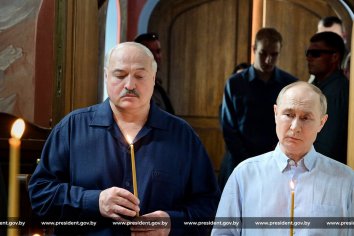
Putin’s correction: Russian leader sees Ukraine and Belarus as Russia
During an August 1 news conference in Valaam, President Vladimir Putin made it unmistakably clear that he considers Ukraine to be Russian territory. His remarks visibly unsettled his guest, Alaksandar Łukašenka. At the event, the Belarusian strongman urged Kyiv to …